

Solar irradiance is the core basic data for evaluating the power generation of photovoltaic power plants, optimizing system design, and formulating operation and maintenance strategies. The accuracy of irradiance measurement directly determines the accuracy of photovoltaic power plant power generation prediction, the rationality of component selection, and the efficiency of operation and maintenance. In the context of the transformation of the photovoltaic industry towards refinement and intelligence, high-precision, portable, and multi parameter synchronous measurement irradiance meters have become essential equipment for the operation, maintenance, and design of photovoltaic power plants. Jiangsu Jingwei Technology Co., Ltd. relies on advanced sensing technology and environmental compensation algorithms to independently develop the JW-F04 portable irradiance meter. With high-precision measurement, multi parameter synchronous acquisition, and strong environmental adaptability as the core, it provides accurate data support for photovoltaic energy resource assessment, power plant performance monitoring, and efficiency analysis. Irradiance collection
The power generation efficiency of photovoltaic systems is closely related to solar irradiance. Under different time periods, seasons, and weather conditions, irradiance varies greatly. Accurately measuring parameters such as total radiation, scattered radiation, and effective irradiance of component planes is a prerequisite for achieving refined management of photovoltaic power plants. Traditional irradiance meters are mostly single parameter measurements with a single function, and cannot synchronously collect multidimensional light energy data; Some devices have low accuracy and are susceptible to interference from factors such as temperature, spectrum, and angle, resulting in large measurement errors; And most of them are fixed installations, which are difficult to meet the flexible measurement needs of distributed power stations, temporary inspections, mobile operations and maintenance scenarios. The R&D team of Jingwei Technology has innovatively adopted a secondary standard spectral response sensor and multi-channel optical detection technology to address industry pain points, creating the JW-F04 portable irradiance meter that achieves multi parameter, high-precision, and portable measurement, helping to improve the quality and efficiency of solar energy monitoring in the photovoltaic industry.
Excellent core measurement performance, precise and reliable data. The JW-F04 portable irradiance meter is equipped with a high-precision secondary standard spectral response sensor, with a spectral response range that matches the sensitive band of photovoltaic modules. It can accurately measure four core parameters: total solar radiation, scattered radiation, reflected radiation, and effective irradiance of photovoltaic module planes. The measurement range is 0-2000W/㎡, with a resolution of 0.1W/㎡ and a measurement accuracy of ≤± 2%, meeting the national secondary metrology standard. The data accuracy far exceeds that of ordinary equipment in the industry. The built-in professional environmental compensation algorithm can automatically eliminate the impact of temperature drift, spectral mismatch, and angle response error on the measurement results. Under the extreme temperature of -30 ℃ to 70 ℃, different lighting angles, and complex weather conditions, stable and accurate measurement data can be output, providing a reliable basis for photovoltaic power generation accounting and performance evaluation.
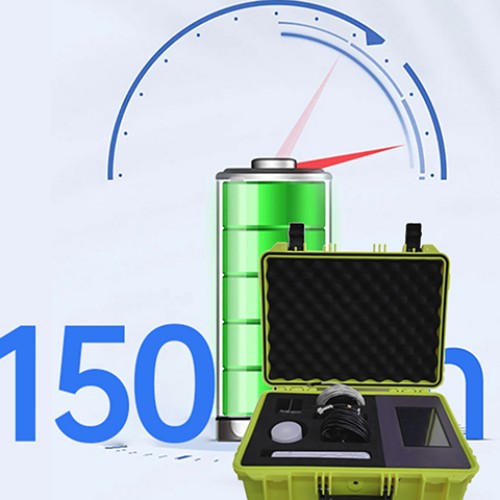
Portable design, adaptable to multiple scenarios and flexible applications. The JW-F04 portable irradiance meter adopts a lightweight body design, with a total weight of only about 3.5kg. It is equipped with a high-strength portable case and has a waterproof and dustproof rating of IP67. It can adapt to harsh outdoor environments such as sandstorms, rain, snow, and direct sunlight, and is not afraid of complex working conditions. The equipment adopts a split structure, with sensors and hosts that can be separated. It is equipped with a 5-meter extension cable, which facilitates flexible placement of sensors and is suitable for flat irradiance measurement of photovoltaic modules in different scenarios such as roofs, mountains, and water surfaces; The host is compact and lightweight, suitable for handheld operation or fixed installation, meeting various needs such as temporary detection, long-term monitoring, and mobile operation and maintenance. The body is equipped with a high-definition LCD display screen, which displays real-time multi parameter measurement data, supports peak data locking, and one click viewing of historical data. The operation is simple and intuitive, and can be quickly mastered without professional training.
Intelligent data management helps to digitize photovoltaic operation and maintenance. The JW-F04 portable irradiance meter is equipped with a large capacity storage module, which can store more than 100000 sets of measurement data. It supports real-time data recording, historical tracing, and trend analysis, making it convenient for operation and maintenance personnel to grasp the dynamic changes in light energy resources. The device is equipped with RS485 communication interface and wireless transmission module, which can be connected to computers, photovoltaic inverters, data collectors and other devices to achieve real-time uploading of measurement data, remote monitoring and data sharing; Equipped with professional data analysis software, it can generate daily, weekly, and annual reports on irradiation levels, draw trend curves of irradiation levels, and perform correlation analysis with power generation data. This provides data support for optimizing operation and maintenance strategies, predicting power generation, and diagnosing faults in photovoltaic power plants, and promotes the transformation of photovoltaic operation and maintenance from "experience management" to "data management".
Widely applicable scenarios, with excellent industry reputation. The JW-F04 portable irradiance meter has been widely used in the entire process scenarios of photovoltaic power station site selection survey, solar energy resource assessment, system design verification, construction acceptance, daily performance monitoring, power generation accounting, component efficiency analysis, etc. It covers various photovoltaic projects such as large-scale ground power stations, distributed rooftop power stations, fishery photovoltaic complementary power stations, and mountain power stations. In key photovoltaic regions such as Jiangsu, Northwest, and North China, this equipment has gained high recognition from numerous power station operators, EPC companies, design units, and testing institutions for its accurate measurement data, convenient operating experience, and reliable quality, making it one of the preferred devices for photovoltaic light energy monitoring.
Jiangsu Jingwei Technology focuses on the research and production of photovoltaic detection and monitoring equipment, always positioning "precision, efficiency, and reliability" as the core of its products. The launch of the JW-F04 portable irradiance meter further improves Jingwei Technology's photovoltaic detection product matrix and provides a core tool for precise monitoring of solar energy in the photovoltaic industry. In the future, Jingwei Technology will continue to focus on technological innovation, continuously optimize product performance, enhance product intelligence level, and support the efficient and sustainable development of the photovoltaic industry with higher quality products and more professional services, empowering the clean energy industry.
Irradiance collection, photovoltaic performance evaluation tool, portable irradiation system thermometer