

Solar irradiance is the core environmental parameter that determines the instantaneous output power of photovoltaic modules. Deviation in irradiance data can directly cause distortion in IV power conversion, inaccurate calculation of power generation, and inaccurate evaluation of power plant efficiency. In the feasibility study site selection, on-site performance testing, and power generation traceability verification of photovoltaic projects, high-precision portable irradiance equipment is indispensable. Jiangsu Jingwei is deeply involved in the field of photovoltaic optical measurement and has launched the JW-F04 portable irradiance meter, which adopts secondary standard thermopile sensor technology to balance measurement accuracy and field portability. It has become a core measurement tool for photovoltaic resource survey, on-site detection, and energy efficiency analysis. Portable irradiation system dosimeter
The JW-F04 core sensor uses thermopile detection elements calibrated by a third-party CNAS laboratory, with excellent cosine angle response characteristics, eliminating measurement errors caused by oblique sunlight and scattered light in the morning and evening. It can synchronously and accurately measure three key data types: total irradiance, scattered irradiance, and effective irradiance on component inclined surfaces. The range covers the full spectrum sunlight range of 0-2000W/㎡, and the measurement error is controlled within ± 3%, which meets the national standard for photovoltaic performance testing and measurement specifications. The instrument is equipped with an intelligent temperature compensation algorithm, which automatically corrects the temperature drift problem of sensors in high and low temperature environments. It works stably in a wide temperature range of -40 ℃~+70 ℃, with an IP67 fully sealed protective body that is dustproof, waterproof, and anti condensation. It is suitable for various extreme photovoltaic field environments such as deserts, coastal high humidity areas, and high-altitude mountainous areas, and does not affect the normal measurement of equipment in outdoor rainy days.
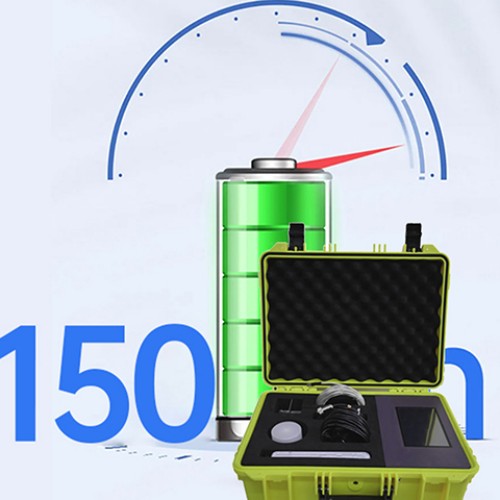
The battery life and portability design meet the needs of field inspections. The whole machine has a palm sized body and a portable buckle design that can hang fixtures on the go. It comes with a large capacity rechargeable lithium battery as standard, and can last up to 150 hours in regular intermittent inspection mode. If 24-hour continuous fixed-point monitoring is required, it can be operated continuously with an external DC power supply; The high-definition segment code LCD screen of the body is highly visible, with one click start stop measurement and one click data storage. The instantaneous irradiation value of a single measurement is automatically recorded, and a large capacity local storage space is built in. It can store tens of thousands of sets of irradiation+temperature and humidity linkage data. The USB interface supports one click export of data to Excel reports, making it convenient for later statistical analysis of daily irradiation changes and monthly irradiation peak patterns. The equipment reserves networking communication interfaces, allowing multiple instruments to be networked nearby, achieving synchronous irradiation collection at multiple points in the photovoltaic field area, remote cloud unified retrieval of monitoring data, and adapting to large-scale photovoltaic cluster resource survey projects.
The landing application scenarios cover the entire process of photovoltaics: During the feasibility study stage of the project, surveyors carried JW-F04 to conduct on-site inspections of the site, collected hourly irradiation data for multiple days, calculated the peak sunshine hours of the site, and provided data basis for the selection of installed capacity and component inclination angle of the power station; During on-site testing of component IV, it is used in conjunction with JW-IV11 to synchronously collect real-time radiation, accurately convert STC standard power, and enhance the reliability of power detection; During the operation and maintenance phase of the power station, compare the measured irradiation with the actual power generation, and investigate abnormal issues such as component attenuation, line loss, and inverter inefficiency; Third party energy efficiency audit institutions rely on equipment to carry out power generation verification and energy efficiency benchmarking work, and issue authoritative radiation verification data.
Relying on Jiangsu Jingwei's comprehensive measurement calibration services, JW-F04 supports annual on-site calibration to ensure long-term stable measurement accuracy of equipment. Since its launch, the product has been widely used in domestic photovoltaic resource surveys, distributed power station acceptance, overseas photovoltaic project surveys, and other projects. With high cost-effectiveness and high precision, it fills the gap in the localization of high-end portable irradiation instruments and continues to help the photovoltaic industry refine the management of solar energy resources.
Portable irradiation system thermometer, photovoltaic performance evaluation tool, portable photovoltaic PR testing system